CrOSSEs Chemical Element Words
Spell crosses with the chemical element symbols of the periodic table.
4 spellings of the word crosses using the elements were found!
CrOSSEs
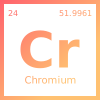
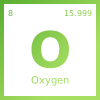
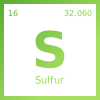
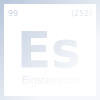
CrOSSeS
CrOsSEs
CrOsSeS
Meaning of crosses
- n A geometrical figure consisting of two straight lines or bars intersecting each other such that at least one of them is bisected by the other.
- n (heraldry) Any geometric figure having this or a similar shape, such as a cross of Lorraine or a Maltese cross.
- n A wooden post with a perpendicular beam attached and used (especially in the Roman Empire) to execute criminals (by crucifixion).
- n (Christianity) A hand gesture made in imitation of the shape of the Cross; sign of the cross.
- n (Christianity) Any representation of the crucifix, as in religious architecture, burial markers, jewelry, etc.
- n (figurative, from Christ's bearing of the cross) A difficult situation that must be endured.
- n The act of going across; the act of passing from one side to the other
- n (biology) An animal or plant produced by crossbreeding or cross-fertilization.
- n (by extension) A hybrid of any kind.
- n (boxing) A hook thrown over the opponent's punch.
- n (soccer) A pass in which the ball is kicked from a side of the pitch to a position close to the opponent’s goal.
- n A place where roads intersect and lead off in four directions; a crossroad (common in UK and Irish place names such as Gerrards Cross).
- n A monument that marks such a place. (Also common in UK or Irish place names such as Charing Cross)
- n A line across or through another line.
- n (surveying) An instrument for laying of offsets perpendicular to the main course.
- n A pipe-fitting with four branches whose axes usually form a right angle.
- n (Rubik's Cube) Four edge cubies of one side that are in their right places, forming the shape of a cross.
- n (cartomancy) The thirty-sixth Lenormand card.
- n (slang) Crossfire.
- adj Transverse; lying across the main direction.
- adj (chiefly British, Ottawa Valley) (of someone) Bad-tempered, angry, annoyed; (of words) tinged with anger.
- adj Made in an opposite direction, or an inverse relation; mutually inverse; interchanged.
- adj (nautical) Of the sea, having two wave systems traveling at oblique angles, due to the wind over shifting direction or the waves of two storm systems meeting.
- v To make or form a cross.
- v To place across or athwart; to cause to intersect.
- v To lay or draw something across, such as a line.
- v To mark with an X.
- v To write lines of text at right angles to and over the top of one another in order to save paper.ᵂ
- v (reflexive, to cross oneself) To make the sign of the cross over oneself.
- v (transitive) To make the sign of the cross over (something or someone).
- v To move relatively.
- v (transitive) To go from one side of (something) to the other.
- v (intransitive) To travel in a direction or path that will intersect with that of another.
- v (transitive) To pass, as objects going in an opposite direction at the same time.
- v (sports) Relative movement by a player or of players.
- v (cricket, reciprocally) Of both batsmen, to pass each other when running between the wickets in order to score runs.
- v (soccer) To pass the ball from one side of the pitch to the other side.
- v (rugby) To score a try.
- v (social) To oppose.
- v (transitive) To contradict (another) or frustrate the plans of.
- v (law) To conduct a cross examination; to question a hostile witness.
- v (biology) To cross-fertilize or crossbreed.
- v (transitive) To stamp or mark (a cheque) in such a way as to prevent it being cashed, thus requiring it to be deposited into a bank account.
- n (obsolete) A coin stamped with the figure of a cross, or that side of such a piece on which the cross is stamped; hence, money in general.
- n (obsolete, Ireland) Church lands.
- n (archaic) A betrayal; dishonest practices, especially deliberately losing a sporting contest.
- adj (archaic) Opposite, opposed to.
- adj (now rare) Opposing, adverse; being contrary to what one would hope or wish for.
- adj (archaic) Dishonest.
- v (UK, Oxford University, slang, obsolete, transitive) To mark a cross against the name of (a student) in the buttery or kitchen, so that they cannot get food there.
- v (transitive, obsolete) To interfere and cut off ; to debar.
- n (Christianity) The cross on which Jesus died and, in metonymical uses, such as to refer to Christ's suffering in general.
- n A number of places with the name "Cross":
- n A place in the United Kingdom:
- n A settlement on the Isle of Lewis, Western Isles council area, Scotland (OS grid ref NB5062).
- n A hamlet in St Dominick parish, east Cornwall, England (OS grid ref SX4067)
- n A hamlet in Georgeham parish, North Devon district, Devon, England (OS grid ref SS4539).
- n A hamlet in Goodleigh parish, North Devon district, Devon (OS grid ref SS6034).
- n A hamlet in Ellesmere Rural parish and Ellesmere Urban parish, north of Ellesmere, Shropshire, England (OS grid ref SJ3936).
- n A village in Compton Bishop parish, Somerset, England, previously in Sedgemoor district (OS grid ref ST4154).
- n A place in Ireland:
- n A village and townland in County Clare, Ireland, Irish spelling An Chrois.
- n A village in County Mayo, Ireland, Irish spelling An Chrois.
- n A place in the United States:
- n An unincorporated community in Berkeley County, South Carolina, United States.
- n An unincorporated community in Mineral County, West Virginia, United States.
- n A town in Buffalo County, Wisconsin, United States.
- n A barangay of Glan, Sarangani, Philippines.
- n A topographic surname from Middle English for someone who lived near a stone cross on a road.
- n (Christianity) Alternative letter-case form of Cross (“the Crucifix, the cross on which Christ was crucified”). [(Christianity) The cross on which Jesus died and, in metonymical uses, such as to refer to Christ's suffering in general.]